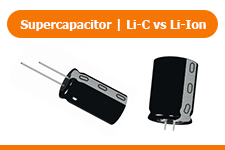
We would like to draw attention to the alternative use of Li-C lithium-ion capacitors as a replacement for classic Li-Ion batteries in electrical energy storage systems. Li-C technology is an interesting combination of the features of supercapacitors and lithium-ion batteries, allowing device designers to introduce new design and functional concepts.
Li-C capacitors have one electrode made of graphite and lithium compounds. This design combines the high power density and very long cycle life characteristic of Supercap (EDLC) capacitors with the higher energy density known from Li-Ion technology.
Technology comparison: Supercap vs Li-C vs Li-Ion
<table>
Key advantages of Li-C capacitors in device design
The use of Li-C capacitors instead of Li-Ion batteries allows for a number of design changes, especially in applications requiring high power, short charging times, and long service life.
First of all, Li-C capacitors can be charged with a current many times higher than lithium-ion batteries. In practice, this means that charging times can be reduced by up to a hundred times, which is crucial in systems that operate cyclically or require frequent recharging.
Another significant advantage is the very high number of operating cycles, ranging from 50,000 to as many as 500,000 cycles, which significantly extends the service life of the energy storage system and reduces maintenance costs.
The high level of safety is also noteworthy. If operating parameters are exceeded or exposed to fire, the Li-C capacitor behaves similarly to an electrolytic capacitor rather than a Li-Ion battery. This reduces the risk of fire and its spread, which simplifies the mechanical design of the device, including reducing or eliminating fire protection covers. In addition, the lithium content in the electrode is low.
Li-C capacitors are also exempt from the restrictive environmental regulations applicable to batteries. They are not formally classified as batteries and are therefore not subject to the same regulations regarding transport, storage, trade, or disposal. They can also be completely discharged during transport or servicing without risk of damage.
A new approach to design – an application example
The differences in design strategy are well illustrated by the example of a city bus. Instead of a large battery that requires many hours of charging, a Li-C capacitor battery with a lower energy capacity can be used, which can be charged in a few minutes – for example, at terminal stops.
Although charging takes place more frequently, the significantly higher number of permissible cycles translates into a longer service life for the entire system compared to a Li-Ion battery. In addition, the lower fire risk simplifies the design of the energy storage enclosure, and the space saved can be used to increase capacity.
Integration and accompanying electronics
Serial connection of Li-C capacitors, as in the case of batteries, requires the use of voltage balancing circuits between cells. Active or passive balancing circuits are most commonly used to ensure safe and uniform operation of the entire module.
For larger projects, it is possible to prepare complete energy storage modules based on Li-C capacitors, in a mechanical form resembling a classic battery or in any dedicated shape tailored to the application.
Available formats and parameter ranges
Individual Li-C capacitors are available in many mechanical designs, including axial, radial, and prismatic housings resembling lithium-ion battery cells.
The typical operating temperature range is −25°C to +70°C. The rated voltage is in the range of 3.8–4.0 V (max. pulse up to 4.35 V), while capacities are available from 1.5 F to 25,000 F, corresponding to energy from approx. 0.002 Wh to 35 Wh.
Example parameters of Li-C capacitors
The 4 V / 25,000 F model offers 35 Wh of energy, 100 A of continuous current, and (up to 3 s) of 400 A. Its ESR resistance is 0.46 mΩ, dimensions are 61 × 138 mm, and weight is 740 g, which translates to an energy density of 47 Wh/kg.
The compact 3.8 V / 50 F capacitor, on the other hand, provides 0.057 Wh of energy, 1.3 A of continuous current, and 1.8 A of pulse current. Its ESR is 0.7 Ω, its dimensions are 10 × 20 mm, and it weighs 3.2 g (17.77 Wh/kg).